There’s never been a better time to expand into the EU. Europe can provide you with stable and fertile ground to win new customers.
The European Union is a prime player in international trade and is one of the world’s most open, outward-focused economies. The EU’s single market has achieved a strong standing on the global stage. The combination of Europe’s established position within international markets and the rising popularity of ecommerce have created the ideal environment for international brands to expand there.
You may feel like expanding to the EU is complex and out of reach, but wherever you’re based we’re here to make it simple. Here are our top 10 reasons why you should expand into the EU right now!
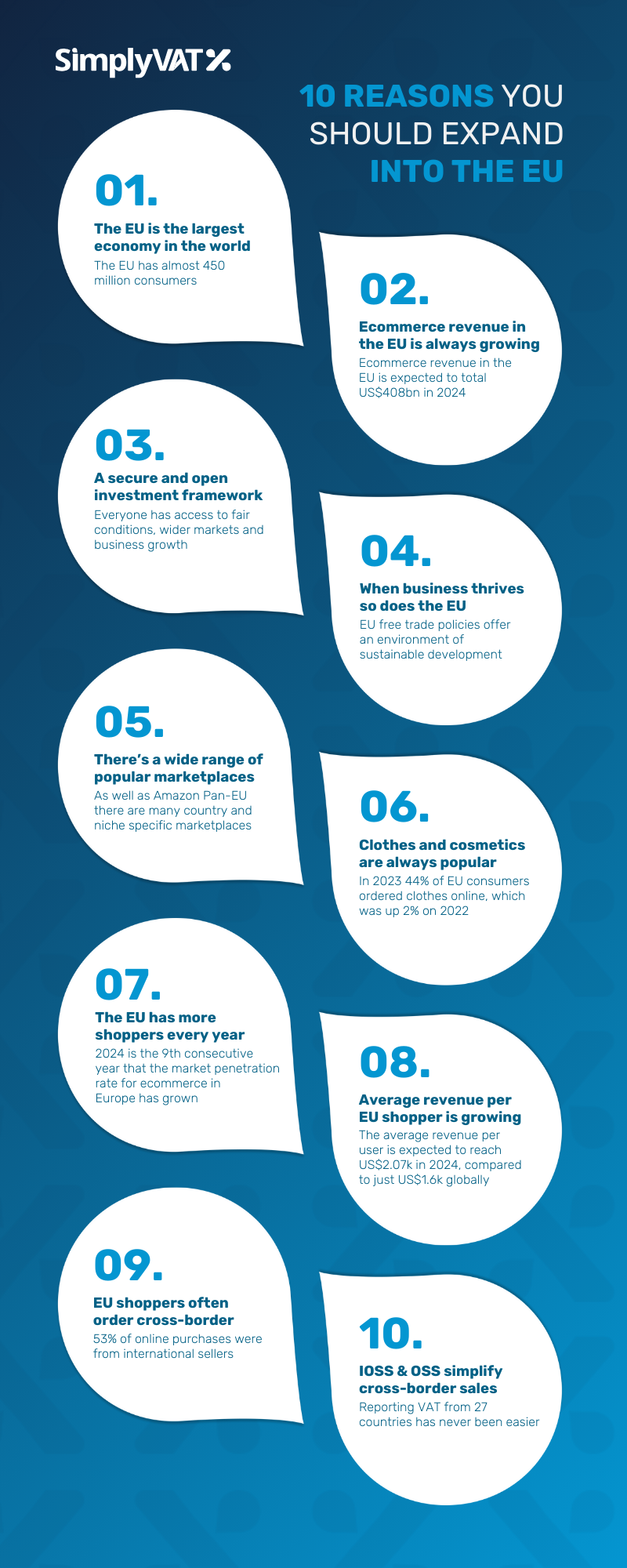
1. The EU is the largest economy in the world
2. Ecommerce revenue in the EU is always growing
Revenue generated in the ecommerce market within the EU is projected to reach US$408.00bn this year and is expected to show an annual growth rate of 9.02%. This means that every year more Europeans are shopping online. Your business will enter a market with rising demand and a growing customer base.
3. It has a secure legal investment framework that is open and transparent
The European Union accounts for 27 countries and is responsible for negotiating an individual trade policy for each member state. These agreements are made on a mutually beneficial basis, so that both EU and non-EU sellers gain fair conditions and access to wider markets to support sustainable development and business growth.
4. When Businesses succeed, so does the EU
The European Union is invested in businesses exceeding. No matter where your business is based, the EU’s free trade policies offer an environment of sustainable development. When you expand into the EU, you’ll have the same opportunities for growth as those based within the Union.
5. There’s a wide range of popular marketplaces within Europe
Amazon is just as prevalent in the EU as it is in the USA. It’s Pan-EU program makes it easy to sell and fulfil to eight European countries. Plus more countries are being added every year, increasing the number of markets you can expand to.
The European market is also full of country and niche specific marketplaces. Many of them are just as (if not more) popular than the likes of Amazon and eBay. These marketplaces can present you a whole new customer base for your niche and are a great way to test the market. If Amazon’s Pan-EU program feels like too much of a commitment, you can effectively test the market in one country at a time.
6. Clothes, home accessories and cosmetics consistently top the list of popular EU products
Eurostat reports that in 2023 44% of EU consumers ordered clothes online, which was up 2% on 2022. Cosmetics and home accessories were the next two most popular categories of goods for all ages. For lots of international businesses looking for popular goods to start selling to EU customers, clothing and cosmetic products are some of the easiest to ship safely and successfully cross-border, making for happy customers and brilliant business.
7. The number of ecommerce users in the EU is growing
The number of EU shoppers using ecommerce as their means of buying goods and services is increasing, reaching 569 million by 2025. 2024 is the 9th consecutive year that the market penetration rate for ecommerce in Europe has grown.
In 2022, the top three EU countries for citizens purchasing goods online were the Netherlands, Denmark and Ireland. Even at the bottom of the list more people are making purchases online. Albania saw an 11% increase in digital shoppers between 2021 and 2022, presenting exciting opportunities for your business.
8. Average revenue per ecommerce user in the EU continues to rise
The average revenue per user is expected to reach US$2.07k in 2024, compared to just US$1,6k globally. User penetration (the number of ecommerce users in the EU) is estimated to be rising to 63% by 2029. In the coming years there will be more and more viable buyers for your goods or services. If you expand into the EU this year, there will still be new potential customers for years to come.
9. EU shoppers are frequently making cross-border purchases
In 2020, 53% of consumers who made purchases online bought goods/services from sellers in another country. Plus, as cross-border marketplace sales increase, EU shoppers are undeterred by potential customs clearances and continue purchasing the quality goods they desire. Launching your product in one EU country gives you easier access to customers in neighbouring states.
10. IOSS and OSS make cross-border sales simple
In 2021, the EU introduced the One Stop Shop schemes to drastically reduced the administrative burden on business looking to supply their customers across the EU. OSS (One Stop Shop) and IOSS (Import One Stop Shop) both enable EU and non-EU sellers to collect and report the VAT collected on their cross-border sales through online portals.
Find out if you’re eligible for the OSS or IOSS schemes. We’ve put together a short quiz you can take to find out whether you can streamline your VAT reporting and save time & money.
Get Started
At SimplyVAT.com our international experts are always happy to help you navigate international VAT and are always at hand to answer your questions. If you’re unsure of your international VAT obligations, or would like to get VAT registered, fill out the form below and a member of the team will be in touch.
"*" indicates required fields